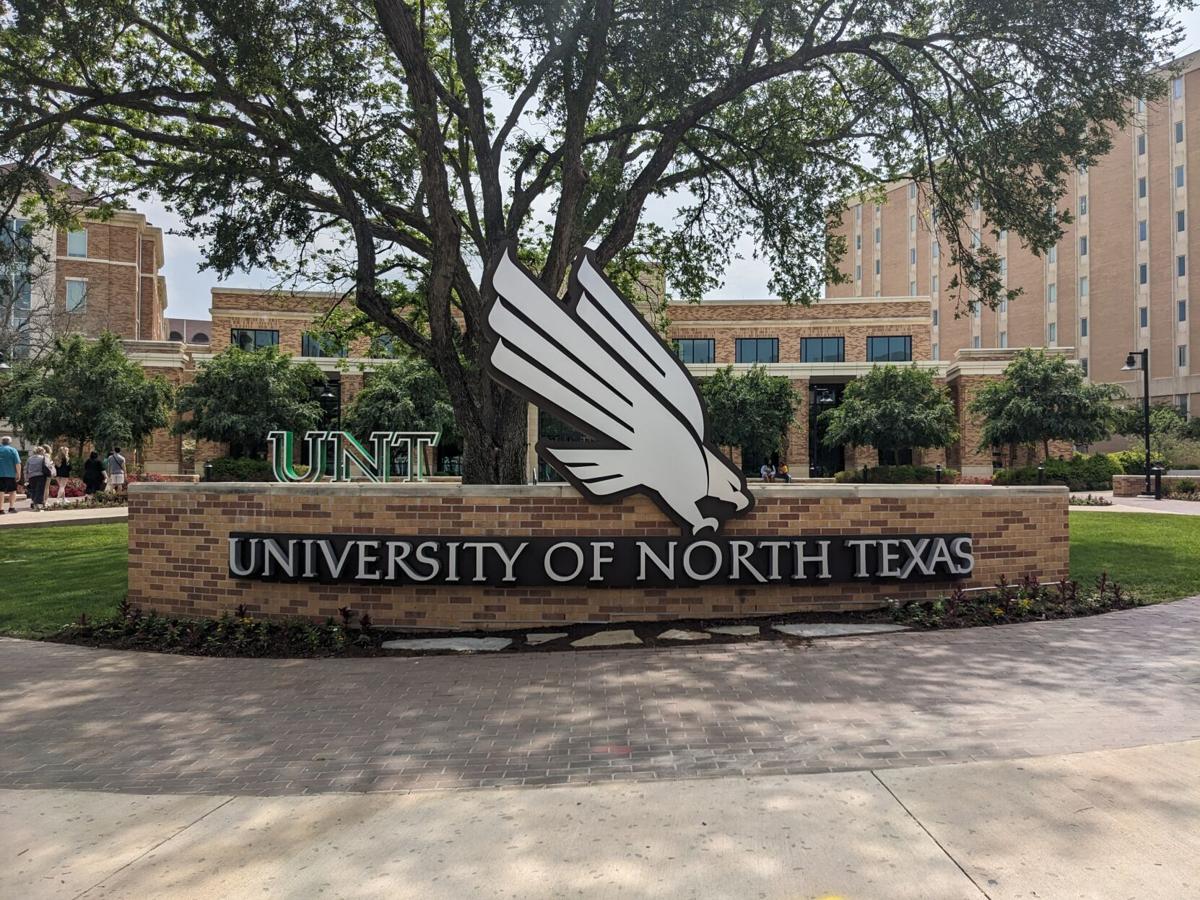
University of North Texas


This degree is a 36-hour program. Requirements include 12 hours of core of and 12 hours of foundation courses. The remaining 12 hours can be taken through a program concentration. If no concentraion is selected, students can take a more general approach by selecting four courses of their choice.
Advancing Learning Through Technology
Preparing educators, researchers, and leaders to leverage technology to transform
learning experiences across educational and professional settings.
Master's in Learning Technologies Program Information
Formats
Online | In-person
36
Credit Hours Required
12
Number of Courses
The Master of Science in Learning Technologies combines theory, research, and hands-on application to help students design effective learning experiences, leverage emerging technologies, and improve learning outcomes across educational and professional settings.
UNT has a proven track record in online delivery and has been teaching students online
for nearly 30 years. You'll learn how technology has shaped education and training,
as well as discover how to create your own online courses, implement learning technologies
theory and practice, and have the option to develop a skill specialty through one
of the four concentrations offered (list below). The MS degree is one a few in the U.S. that is aligned with the International Society
for Technology in Education's (ISTE) National Educational Technology Standards (NETS).
Courses
Core Courses (12 hours)
Please visit the UNT Graduate Catalog* for updated program information and course descriptions. (*Select the current year Graduate Catalog in the upper right drop-down menu)
-
LTEC 5210 - Instructional Systems Design I
-
LTEC 5220 - Multimedia in Technology Applications
-
LTEC 5610 - Analysis of Research in Learning Technologies
-
LTEC 5580 - LTEC Capstone: Integrated Portfolios (to be taken during the last six hours of coursework)
Foundation Courses (12 hours)
-
LTEC 5030 - Foundations of Learning Technologies
-
LTEC 5200 - New Technologies of Instruction
-
LTEC 5300 - Learning and Cognition
-
LTEC 5510 - Technology-Based Learning Environments
Concentrations
Students can complete one of the program concentrations listed below. Alternatively, students may choose no concentration wherein they choose any four (4) elective courses in addition to completing any core or foundation courses.
Track information for students who began the program prior to Fall 2023: LT-MS Tracks Prior Fall 2023
AI in Education
-
Effective implementation of AI in education requires leaders who understand AI and are able to adjust teaching to the rapid changes in AI. These AI specialists will guide learning and policy making in both educational and business institutions. The AI in Education concentration prepares students for careers such as District Administrator of AI integration, AI Content Maker, Curriculum Director in AI, and Mathematics Education AI Trainer. Courses include:
LTEC 5701: Introduction to AI in Education
This course provides a comprehensive introduction to the principles and technologies behind generative AI and its applications in educational settings. Students will explore foundational concepts, including machine learning, neural networks, large language models, and prompt engineering. Emphasis will be placed on how these technologies can be used to create interactive and adaptive learning experiences.
LTEC 5702: Evaluation of Generative AI Tools in Education
Through a combination of lectures, case studies, and hands-on evaluations, students in this course will explore how GenAI applications can enhance teaching and learning experiences. By the end of the course, students will be equipped to analyze and assess GenAI solutions in diverse educational settings to inform best practices and drive innovation.
LTEC 5703: Ethical and Social Impacts of AI in Education
This course provides a comprehensive examination of the ethical and social implications of artificial intelligence in education. Through critical exploration and discussion, learners will engage with ethical dilemmas, social impact, and cultural considerations inherent in AI applications such as adaptive learning systems, smart tutors, and personalized learning environments.
LTEC 5704: Generative AI Technologies for Learning and Performance
This course explores the design, development, and implementation of Generative AI-powered chatbots to enhance learning and performance in educational settings. Through hands-on projects and case studies, students will gain experience in building effective chatbot systems that facilitate meaningful interactions and promote learner success.
These four courses may be taken to complete a:
- Stand-alone Graduate Academic Certificate AND/OR
- Learning Technologies Masters degree with an AI in Education concentration.
A single course can be taken independently or as an
- Elective for any UNT graduate program.
Openings are still available in LTEC 5701 and LTEC 5702 (either in person or arranged for online) for Fall 2025. For more information, contact Dr. Deborah Cockerham at deborah.cockerham@unt.edu.
Learning Analytics
The Learning Analytics concentration is designed for individuals who are interested in applying data-driven techniques to understand and improve learning processes both in education and in business. The Learning Analytics concentration prepares students for data-centered careers, including Learning Analytics Application Developer, Workforce Analyst, Advanced Analytics Analyst, and Machine Learning Engineer. Courses include:
LTEC 5601: Introduction to Learning Analytics
This course provides an introduction to learning analytics with a focus on Python programming and Exploratory Data Analysis (EDA) in educational contexts. Through hands-on projects and real-world education datasets, students will explore patterns in student performance, engagement, and learning behaviors, gaining practical skills relevant to educational research and decision-making.
LTEC 5602: Predictive Modeling in Learning Analytics
This course explores predictive modeling techniques in the context of learning analytics,
focusing on how machine learning can be applied to educational data to inform decision-making
and improve student learning outcomes. Through hands-on exercises and case studies,
students will develop the skills to build, interpret, and evaluate predictive models
tailored to educational research and policy.
LTEC 5603: Text Mining and Natural Language Processing in Learning Analytics
This course focuses on text mining and Natural Language Processing (NLP) techniques
specifically applied to learning analytics. Students will explore sentiment analysis,
topic modeling, and advanced text analysis using Large Language Models (LLM) and Generative
AI (GAI). Through hands-on projects with education-related datasets, they will develop
practical skills in processing and interpreting unstructured text data to enhance
student learning experiences and educational decision-making.
LTEC 5604: Dashboard Design in Learning Analytics
This capstone course focuses on the design, development, and deployment of interactive
dashboards for learning analytics. Using various Python frameworks, students will
build dynamic dashboards that communicate insights from Exploratory Data Analysis
(EDA), predictive models, and text analysis in meaningful ways for educators, administrators,
and policymakers.
These four courses may be taken to complete a:
• Stand-alone Graduate Academic Certificate AND/OR
• Learning Technologies Masters degree with a Learning Analytics concentration.
A single course can be taken independently or as an
• Elective for any UNT graduate program.
Openings are still available in LTEC 5601 (either in person or arranged for online)
for Fall 2025. For more information, contact Dr. Deborah Cockerham at deborah.cockerham@unt.edu.
Instructional Design and Technology
-
The Instructional Design and Technology (IDT) concentration focuses on the practice of maximizing the effectiveness, efficiency, and appeal of instruction and other learning experiences. The process consists of determining the current state and needs of the learner, defining the end goal of instruction, and creating instruction to assist in the transition. The process is informed by pedagogically tested theories of learning. In addition, students are immersed in creating, managing, and evaluating instructional systems. Graduates of the IDT concentration are prepared to work as instructional designers or learning experience designers in corporate, higher education, K-12, and other instructional and training environments.
Students take the following two (2) courses:
- LTEC 5040 - Online Design and Pedagogy
- LTEC 5310 - Human-Computer Interaction
And complete two (2) of the following:
- LTEC 5260 - Computer Graphics for Mediated Communications
- LTEC 5420 - Web Authoring
- LTEC 5421 - Advanced Web and Media Development
- LTEC 5211 - Instructional Systems Design II
Teaching and Learning with Technology
-
Teaching and Learning with Technology (TLT) is designed for educational professionals serving in administrative, teaching, or research capacities in a variety of educational settings. This concentration focuses on theoretical foundations, technology skills, technology integration strategies for teaching and learning, active research, innovations in technology, and paradigms for effective online delivery assessment. The degree emphasizes application-oriented technology skills that are valuable for independent study and research, classroom teaching, and personal and professional projects. Graduates of the TLT concentration are prepared to work with the latest educational technologies and effectively use learning technology to improve teaching and learning. This program concentration enables professionals to select and evaluate appropriate technology tools based on the needs of students and curricula. The TLT concentration specifically builds skill sets that empower you to work in educational positions in K-20 and higher education.
Students take the following four (4) courses:
- LTEC 5040 - Online Design and Pedagogy
- LTEC 5111 - Introduction to Video Technology
- LTEC 5260 - Computer Graphics for Mediated Communications
- LTEC 5420 - Web Authoring
Workforce Leadership and Performance Management
-
The Workforce Leadership and Performance Management concentration is designed for individuals seeking careers in leadership development, human resource development, entrepreneurial management, or workforce development. Individuals who earn this degree develop skills that lead to career opportunities in the corporate sector, public organizations, and non-profit agencies. Graduates assume leadership and managerial roles as training/learning and development directors, organization development managers, entrepreneurs, and consultants.
Students select four (4) of the following courses:
- LTEC 5100 - Foundations of Workforce Learning & Development
- LTEC 5121 - Corporate Training Presentation Skills
- LTEC 5470 - Interpersonal Skills Development
- LTEC 5640 - Organization Development, Technology and Change
- LTEC 5650 - Technology Entrepreneurship
- LTEC 5660 - Project Management
- LTEC 5670 - Distributed Leadership
- LTEC 5900 - Advanced Project Management
- Academic Advising
Once admitted, schedule an appointment with your advisor by visiting Graduate Advising or by emailing CI-Advising@unt.edu along with your 8-digit ID number.
Financial Aid
Students should visit FinancialAid.unt.edu for details on Financial Aid and the application process.